
- News
- Regional business helped regional parties grow after 1991 and vice versa
This story is from November 27, 2016
Regional business helped regional parties grow after 1991 and vice versa
Regional parties and businesses have grown in tandem, said former media adviser to Prime Minister Manmohan Singh Sanjaya Baru at a session on 25 years of economic reforms at the Times Lit Fest Delhi on Sunday.
Regional business helped regional parties grow after 1991 and vice versa
Much of the economic changes of the last 25 years can be understood if we look at the political alignments since 1991, and studying this period will give us pointers to deal with the world going forward. Regional parties and businesses have grown in tandem, said former media adviser to Prime Minister Manmohan Singh Sanjaya Baru at a session on 25 years of economic reforms at the Times Lit Fest Delhi on Sunday.
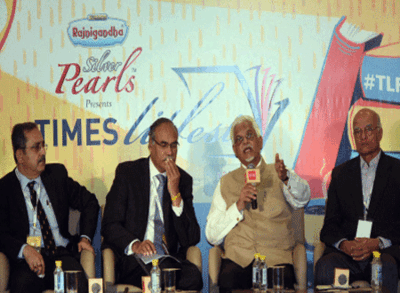
Twenty-five years later is a good time to examine the forces and the factors that took India down the path of liberalization, and four experts who were in the thick of things during the rollout of the 1991 reforms, talked about the significance of that moment in India’s economic history. Baru was sharing the stage with former chief economic advisor Ashok Lahiri, former national security adviser Shivshankar Menon and Harsha Vardhana Singh, former deputy director-general of the World Trade Organisation.
Baru explained that between 1990 and 1950, there were changes in the Indian economy that led to the emergence of new business groups in peninsular India and Punjab. “But the politics of the country was still dominated by north India and the licence permit raj meant power was centralized in Delhi. A businessman from the south could wait in Delhi for days and not enter Udhyog Bhavan while the old business houses could go have tea with the PM,” he said. So regional businesses, after liberalisation, contributed to the growth of regional parties and vice-versa.
Former chief economic advisor Ashok Lahiri said that India was a bit late to the game and hadn’t read the signs in the world around it. “In 1979, when China was following the economics of Adam Smith and the politics of Marx, India was still following the economics of pluralism and the policies of Marx,” he said. Singh concurred, saying that if you protect a market for too long it becomes uncompetitive and trade policy needed change if India was to engage with the world.
Menon pointed out that the lessons from that period when both India and the world were going through radical changes can be applied to India’s engagement with the world going forward. “Today, we are in a period of fundamental change again, not just because of the demagogues who are in power everywhere but also in the way we are witnessing the fragmentation of economics —de-globalisation, in a sense,” said Menon.
Twenty-five years later is a good time to examine the forces and the factors that took India down the path of liberalization, and four experts who were in the thick of things during the rollout of the 1991 reforms, talked about the significance of that moment in India’s economic history. Baru was sharing the stage with former chief economic advisor Ashok Lahiri, former national security adviser Shivshankar Menon and Harsha Vardhana Singh, former deputy director-general of the World Trade Organisation.
Baru explained that between 1990 and 1950, there were changes in the Indian economy that led to the emergence of new business groups in peninsular India and Punjab. “But the politics of the country was still dominated by north India and the licence permit raj meant power was centralized in Delhi. A businessman from the south could wait in Delhi for days and not enter Udhyog Bhavan while the old business houses could go have tea with the PM,” he said. So regional businesses, after liberalisation, contributed to the growth of regional parties and vice-versa.
Former chief economic advisor Ashok Lahiri said that India was a bit late to the game and hadn’t read the signs in the world around it. “In 1979, when China was following the economics of Adam Smith and the politics of Marx, India was still following the economics of pluralism and the policies of Marx,” he said. Singh concurred, saying that if you protect a market for too long it becomes uncompetitive and trade policy needed change if India was to engage with the world.
Reforms weren’t just a domestic affair, they coincided with huge geopolitical shifts and the end of the rigidities that the Cold War imposed on countries. “In those years, Narasimha Rao recognised the reality of a unipolar world and brought an economic aspect to foreign policy,” said Menon. “He forced us to think of an India integrated into the world in much wider ways than we had before. He saw opportunities everywhere and forced us to chase them at a time when no one knew where the world was going.”
Menon pointed out that the lessons from that period when both India and the world were going through radical changes can be applied to India’s engagement with the world going forward. “Today, we are in a period of fundamental change again, not just because of the demagogues who are in power everywhere but also in the way we are witnessing the fragmentation of economics —de-globalisation, in a sense,” said Menon.
End of Article
FOLLOW US ON SOCIAL MEDIA
Hot Picks
TOP TRENDING
Trending Stories
In Section
Entire Website
- 'We were treated like slaves, made to work for 15 hours a day': Tricked into Ukraine war, 3 from Karnataka return home
- 'My father was on the flight': Jaishankar opens up about 1984 Air India hijack
- Airtel CEO Gopal Vittal sends letter to Reliance Jio, Vodafone-Idea, Tata Tele and BSNL CEOs; here's what he said
- Prince Harry to celebrate 40th birthday away from Meghan Markle
- Haitian immigrant pet-eating row: Ohio woman accused of eating cat is US citizen, video is not from Springfield
- Kejriwal out of jail; 'CBI arrest only to frustrate ED case bail': SC judge
- Donald Trump reveals what Laura Loomer is to his campaign: 'I don't control her'
- Hamster Kombat Daily Cipher Codes and Combo Cards for September 14, 2024: Unlock up to 1 million coins
- Laura Loomer's photo with Donald Trump viral. People ask where's Melania, where's wedding ring
- Garena Free Fire MAX redeem codes for September 13: Win in-game goodies and rewards
- Kolkata rape-murder case: Ex-principal, policeman arrested for destruction of evidence
- Mamata's olive branch to doctors fails to end RG Kar impasse - Top developments
- 'I was molested in ambulance in which my husband was fighting for life'
- 'Nafrat ki dukaan pe ...': PM Modi attacks Congress over 'brutality' in US
- LIVE: Neeraj Chopra eyes title in Brussels DL Final
- Meerut building collapse: 3 dead; rescue ops continue
- Will Germany’s suspension of Schengen entry end the Europe dream?
- Bengaluru woman sparks controversy with comments about Swiggy delivery executive
- 'Look at Virat Kohli': Ex-Pak captain wants Babar to...
- Earth to get second 'mini-moon': Here's what you need to know

Popular Categories
Hot on the Web
Top Trends
Trending Topics
World Largest HorseEID WishesGreen Apple BenefitsPriyanka Chopra TattooKottukkaali OTT ReleaseNarendra ModiGhaziabad Juice SellerHair LossSudha MurtyMalayalam ProducersIndia's Best Dancer 4Simi GarewalDilli BabuIndian National ParksLaung BenefitsVikas SethiApple iPhone 16Donald TrumpAadhar Card UpdateWordle Answer
Living and entertainment
Latest News
Kaun Banega Crorepati 16: Can you guess the answer for this Rs 3,20,000 question on Navy, which contestant Naman Jain incorrectly answered?IIM Jammu hosts 'Fostering Academia and Industry Partnerships' event at BengalaruMP Bharat, TDP Andhra President Srinivas promise action to safeguard protection of steel plant workersLiverpool slump to shock 1-0 home defeat by Nottingham ForestVinith Venkatesh scores in ISL debut as Bengaluru FC edge past East BengalJitendra Jorwal takes charge as new Ludhiana deputy commissioner, vows seamless delivery of servicesAnanya Panday urges all industries to form Hema Committee': 'Clearly, no one else is doing it but women'Nine arrested on charges of assaulting a Dalit woman at Kallukunta village in Kurnool district'Calling all Swifties for Trump': Donald's new campaign merch imitates Eras Tour shirtsWWE Hall of Famer Watches 15 Hours Of Wrestling Each WeekDallas Cowboys Set to Defend AT&T Stadium in Week 2 Clash with New Orleans SaintsTovino on training for Kalaripayattu in ‘ARM’: I practiced every single day, even if I had a hectic day on set8 animals that reproduce without matingDelhi Police Files FIR for Firecracker Celebration Outside CM Kejriwal's ResidenceThrowback: When Alia Bhatt responded to insecurity questions about Ranbir Kapoor, shut down gossipIndia's T20I captain Suryakumar Yadav turns 34: A glimpse into his stellar T20 careerThe 3 Strongest Zodiac Signs: Powerhouses of the Zodiac Wheel7 benefits of drinking lemon water with black salt daily
Copyright © 2024 Bennett, Coleman & Co. Ltd. All rights reserved. For reprint rights: Times Syndication Service